AI Visibility
What Is GEO (Generative Engine Optimization)? The 2026 Guide for Business Websites
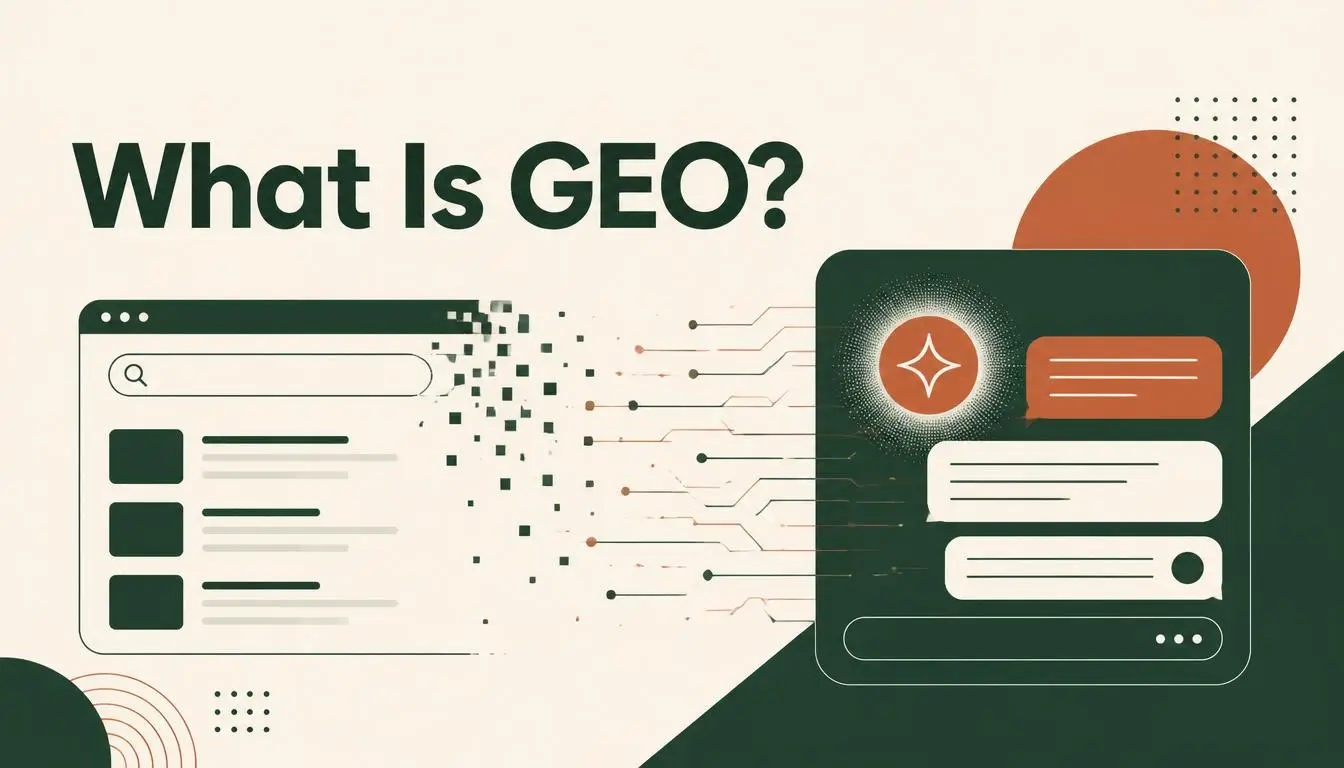
Generative Engine Optimization (GEO) is the practice of structuring your website so AI systems — ChatGPT, Google AI Overviews, Perplexity, Gemini, Copilot — can find your content, understand it, and quote it by name when they answer someone’s question. Classic SEO earns you a place among ten blue links. GEO earns you a place among the two to seven sources an AI actually names out loud.
A client asked me a version of the same question three times last month: “why does none of this matter if people just ask ChatGPT now?” It’s a fair question, and it’s the wrong way to frame it. People asking ChatGPT instead of typing into Google doesn’t mean visibility stopped mattering — it means visibility moved. The engines changed. The mechanics of earning a mention didn’t disappear, they got rewritten, and most small business websites haven’t caught up yet.
That gap is what GEO is about. Not a replacement for SEO, not a trend to bolt onto a homepage, but a real shift in how a page needs to be built if you want an AI system to trust it enough to cite it.
Why now
The shift from clicking to asking
For twenty years, the job of a website was to earn a click from a results page. That’s still true — but it’s no longer the only game. A growing share of research, comparison shopping and “who should I hire for this” questions now happen entirely inside a chat window, and the person never sees a list of ten links at all. They see one answer, built from a handful of sources the AI decided were worth quoting.
Industry analysts, including Search Engine Land’s 2026 GEO playbook, describe this as a genuinely different competition: instead of ranking among ten results, a brand is competing to be one of the two to seven sources a language model actually names in a single response. Fewer slots, higher stakes, and — this is the part most agencies skip — a completely different set of rules for what earns a slot.
GEO vs. SEO: two disciplines, one foundation
I still get asked whether GEO “replaces” SEO. It doesn’t, and treating it that way is how businesses waste budget. GEO sits on top of SEO’s technical foundation — clean HTML, fast pages, crawlable content, clear site structure. Take that foundation away and an AI system can’t retrieve your page in the first place, no matter how well-written it is.
| Traditional SEO | GEO | |
|---|---|---|
| Goal | Rank in the top 10 results | Get cited inside an AI-generated answer |
| Success signal | Ranking position, click-through rate | Mention rate, citation rate, position within the answer |
| Content style | Keyword-targeted pages | Question-first, evidence-dense, quotable |
| Core requirement | Backlinks, on-page optimisation | Structured data, factual density, clear entities |
What actually earns a citation (and what doesn’t)
Most “GEO tips” floating around right now are guesses. One of the few controlled studies on this — a joint research project involving Princeton, published on arXiv — tested nine content tactics against each other to see what actually moved the needle on AI citations.
The same research found what doesn’t work: keyword stuffing, padding a page to hit a word count, or artificially “dumbing down” content without adding real substance. None of that moved citation rates. If a tactic wouldn’t help a human reader trust the page, it doesn’t help an AI system trust it either — which, honestly, is a relief. It means writing genuinely useful content is still the strategy, not a workaround for one.
The technical foundation AI engines need
Before an AI system can quote a sentence from your site, it has to be able to retrieve and parse the page reliably. That comes down to the same technical fundamentals that have always mattered for SEO, just with less tolerance for shortcuts:
- Clean, semantic HTML — real headings in a logical order, not styled paragraphs pretending to be titles.
- Fast, stable pages — Core Web Vitals aren’t a vanity metric here; a slow or shifting page is harder to crawl and parse cleanly.
- Structured data — JSON-LD schema that describes what a page actually is, using Google’s own structured data guidelines and the shared vocabulary at schema.org.
- Clear entity signals — a named author, a real organisation, consistent facts about who you are across every page.
This is the part we handle as technical SEO and Core Web Vitals work before a single line of GEO-focused copy gets written — building on a foundation that isn’t solid is the single most common reason a GEO effort goes nowhere.
Writing content that gets quoted
Once the technical base is solid, the writing itself has to change shape. AI systems pull short, self-contained sections from a page rather than reading it top to bottom the way a person might, so the sections need to hold up on their own:
- Open sections with the answer, not the build-up — say the thing, then explain it.
- Match the phrasing people actually use when they ask a question, not the phrasing a marketing team prefers.
- Back claims with a specific number, date, or named source wherever you can.
- Keep paragraphs short enough to lift out cleanly as a standalone answer.
It’s a different skill from writing for a click. Our SEO copywriting work is built around exactly this shift — content designed to be extracted, not just skimmed.
What about FAQ schema?
Worth addressing directly, since it changed this year: Google retired the visible FAQ dropdown from Search results in May 2026, after restricting it to a handful of government and health sites back in 2023. If you’ve seen an agency promise you “FAQ rich snippets” as a 2026 SEO tactic, that promise is out of date.
FAQPage schema itself is still a valid, useful structured data type — it just doesn’t buy extra space in a Google results page anymore. Where it still earns its keep is exactly the topic of this article: giving AI systems a clean, pre-structured set of question-and-answer pairs to parse and quote. That’s why you’ll still find one at the bottom of this page.
How to actually measure GEO
You can’t manage what you don’t track, and classic SEO metrics — rankings, impressions, click-through rate — don’t capture AI visibility at all. Three numbers worth watching instead:
- Mention rate — how often your brand name shows up across a set of prompts an ideal customer might actually type.
- Citation rate — how often that mention comes with an actual clickable link back to your site.
- Position — whether you’re named first in the answer or buried at the end, which affects how much a reader trusts and acts on it.
Where to start, in order
- Confirm your pages are actually crawlable and fast — see our technical SEO audit.
- Add clean, accurate structured data across your key pages.
- Rewrite your most important pages so every section can stand alone as an answer.
- Define 15–20 real prompts a customer might type, and test what currently gets cited.
- Track mention rate and citation rate monthly, not just rankings.
If that list feels like a lot to take on alongside everything else running a business involves, it’s genuinely fine to hand it off — this is what our AI Visibility service exists for, and it’s built into our Growth package for anyone starting from scratch.
Not sure where your site currently stands with AI engines?
Tell me about the project and I’ll take an honest look at where you’re already visible and where you’re invisible.
Start a projectFrequently asked questions
What is GEO in SEO?
GEO (Generative Engine Optimization) is the practice of structuring a website’s content and technical setup so AI systems such as ChatGPT, Google AI Overviews, Perplexity and Copilot can find, understand and cite it when answering a question. Traditional SEO earns a ranking position; GEO earns a mention inside an AI-generated answer.
Is GEO the same as AEO?
They overlap heavily. AEO (Answer Engine Optimization) usually refers to structuring content to directly answer a specific question, while GEO is the broader discipline covering AI citation across chat-based engines. In practice most agencies, including ours, treat them as one connected workstream rather than two separate services.
Do I still need traditional SEO if I invest in GEO?
Yes. GEO is not a replacement for SEO — it is built on top of it. AI engines still rely heavily on the same crawlable, fast, well-structured pages that rank in classic search. A site with weak technical SEO will not perform well in AI answers either.
Does FAQ schema still help my website in 2026?
Google retired the visible FAQ dropdown rich result from Search in May 2026, so FAQ schema no longer produces that accordion snippet. The FAQPage schema type is still valid, still read by Google, and still useful for AI systems that parse structured data to understand a page — it is just no longer a shortcut to extra space in classic search results.
How long does it take to see results from GEO?
New, well-structured content can start entering AI citation pools within days, but consistent, measurable citation rates typically take a few months of steady publishing, technical cleanup and monitoring — similar to how classic SEO compounds over time rather than producing overnight results.