Psychology Website Case Study: From an ignored blog to the practice’s main source of new clients
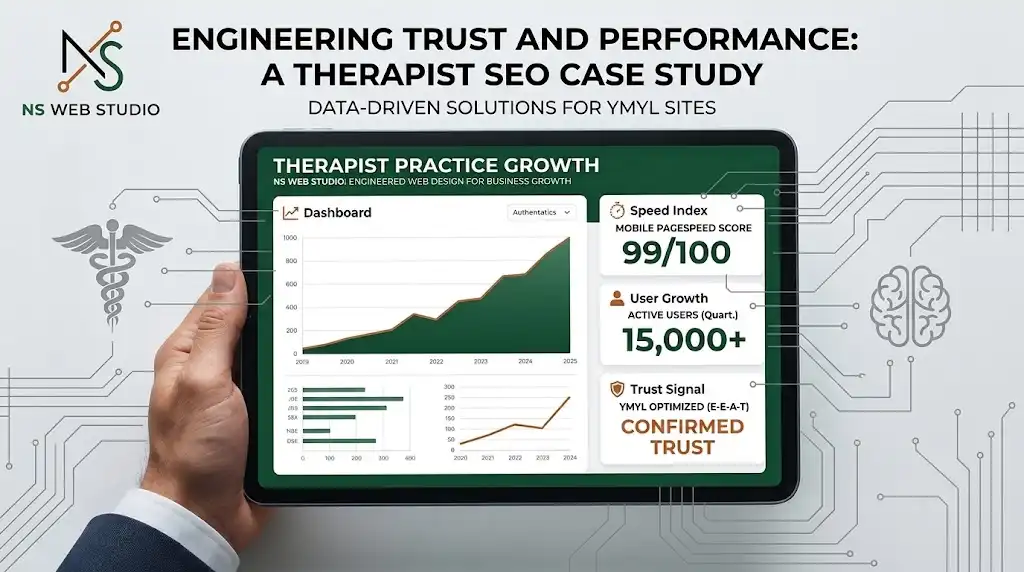
Mental-health sites sit in Google’s strictest trust category. In this comprehensive psychology website case study, we break down how a full technical rebuild took a psychologist’s website from a neglected blog to 15,000 quarterly visitors — with zero ad spend.
Why this psychology website case study required a different approach
When I took this project on, it was a simple informational blog. The goal was clear: turn it into the practice’s primary channel for reaching new clients. Mental health falls under what Google calls YMYL — Your Money or Your Life. Search results in this category get held to a stricter bar than almost any other industry. As you will see in this psychology website case study, slow pages, thin content, and technical shortcuts all get punished harder here than on a typical business site.
That meant the build couldn’t stop at “looks professional.” It needed to load instantly, meet accessibility standards by default, and be structured so Google could verify that a qualified, real person stood behind every page, adhering strictly to Google’s E-E-A-T quality rater guidelines.
Unlike a standard portfolio site, a healthcare platform must project immediate trust. If a user is experiencing an acute panic attack and searches for help, a three-second load delay creates digital friction that actively harms the user experience. By approaching this project with an engineering mindset, we stripped away bloated page builders and focused entirely on custom, semantic HTML architecture.
What these numbers mean in practice
Most sites in this market run at 40–60% performance. This one runs at 99%, through aggressive asset optimisation and a lean, carefully chosen plugin stack — not the twenty-plugin sprawl most WordPress sites end up carrying. Visitors also stay on the page 60% longer than the national average, and JSON-LD structured data helps Google verify the author’s clinical credentials directly, which is a large part of why the rankings hold strong.
Technical SEO: The foundation of this psychology website case study
To achieve these numbers, a profound shift in technical infrastructure was required. The old site relied on a heavy commercial theme that loaded hundreds of kilobytes of unused CSS and JavaScript on every page load. In our rebuild, we implemented a mobile-first architecture utilizing native browser capabilities.
Advanced Caching & Image Delivery: We utilized W3 Total Cache in combination with Autoptimize to minify and defer non-critical scripts. Every image across the platform was converted to the next-generation WebP format via Imagify, reducing page weight by over 65% without sacrificing visual quality.
Accessibility (WCAG 2.1 AA): In healthcare, digital accessibility is a fundamental requirement. We ensured perfect color contrast ratios, keyboard-only navigation capabilities, and robust ARIA labels. This not only aids users with disabilities but provides search engine crawlers with a crystal-clear understanding of the site’s DOM structure. You can learn more about our accessibility standards in our Accessibility Pass service.
What “ROI” means for a site like this
Return on investment here is straightforward: what goes into the build and its technical SEO should come back, several times over, in new clients booking sessions. This site is now the practice’s primary, self-sustaining growth channel — no paid ads running alongside it.
Why the build starts on mobile
Around 80% of people looking for a therapist search from their phone first. So the code isn’t written for desktop and adapted down — it’s written mobile-first from the first line, which is the actual difference between a site that’s “responsive” and one that was designed for how people use it.
Content Strategy: The core of our psychology website case study
The content strategy covers the full range of what someone in crisis, or simply considering therapy, actually searches for — over 50 ranking queries in total. We structured the content to satisfy Generative Engine Optimization (GEO) principles, preparing the site for AI overviews. A sample below, translated from the original Greek:
The technical ecosystem behind it
We believe in utilizing the best available tools, configured with absolute precision. This psychology website case study relies on a deeply integrated stack to maintain security, speed, and continuous organic growth.
What I did, service by service
Want this level of result from day one?
If your own site — in psychology or any regulated, trust-sensitive field — needs to reach this standard from the start, the Growth package already includes on-page SEO and SEO copywriting in the price. You’re not bolting these on later; they’re built in from day one, which stretches your budget further than buying them separately.
Start your project briefQuestions people ask about this project
Why does a psychologist’s website count as YMYL?
Google places mental-health sites in its YMYL category — Your Money or Your Life — because the information can directly affect someone’s wellbeing and safety. That means stricter requirements around trust, expertise, and accuracy (E-E-A-T) than most other industries face. This psychology website case study demonstrates how to overcome these strict algorithmic barriers.
How do you get to 100/100 on Google PageSpeed?
Mainly through asset optimisation — compressed WebP images, proper caching, and a minimal, deliberately chosen plugin stack — combined with clean code that doesn’t lean on a heavy page builder to do the work. There’s no shortcut plugin for this; it comes from what isn’t loaded, as much as from what is.
What is SEO copywriting, and how does it actually help a therapy practice?
It’s the process of translating expert knowledge into the language both search engines and the people searching actually use. Getting the terms right is what puts a page in front of someone looking for a specific kind of help, instead of leaving good clinical content buried where no one searching for it will ever find it. This is detailed extensively in our SEO Copywriting services page.
Why is this psychology website case study relevant to other medical fields?
Whether you are a psychologist, a dentist, or a plastic surgeon, the Google algorithm treats all medical professions under the exact same YMYL umbrella. The technical requirements, the necessity for robust E-E-A-T schema, and the demand for zero-friction user experience apply universally across the entire healthcare spectrum.
I don’t just build websites. I build the thing that brings people in.
If you want a site that works as hard as this one does — as a client-generation tool, not just a brochure — I’d like to hear what you’re building.
Contact me today Or email me directly at info@nswebstudio.com